
Most of Rwanda’s main roads are smooth tarmac, so the off-road driving starts only when you turn towards a park gate, a lodge or a lake-shore track. This Rwanda off road driving guide focuses on those final kilometres. It explains how to use four-wheel drive properly, how to read mud and slopes, and what to do if you get stuck.
Where You Will Actually Drive Off Road in Rwanda
Knowing where the rough sections are helps you plan your day. In general, the hard parts are short but can be tricky after rain.
- Akagera National Park: gravel and sandy tracks, some with deep ruts and loose patches.
- Volcanoes trailheads: steep, rocky access roads that climb from Kinigi towards the trek starting points.
- Lake Kivu shore: parts of the Congo Nile route are unpaved, hilly and slippery when wet.
- Rural lodges: many sit at the end of short dirt roads with sharp gradients.
Nyungwe’s main road is tarmac, but forest tracks and lodge drives can be muddy. See our Volcanoes National Park guide for what to expect near the trailheads.
Understanding Your 4×4 Before You Leave Kigali
Every vehicle is slightly different, so ask for a demonstration at pick-up. Five minutes now saves a lot of stress on a muddy hill later.
Key controls to learn
| Setting | When to use it |
|---|---|
| 2H (two-wheel drive high) | Tarmac and dry, firm gravel. |
| 4H (four-wheel drive high) | Loose gravel, light mud and wet park tracks. |
| 4L (four-wheel drive low) | Steep climbs or descents, deep mud and rocky sections. |
| Diff lock (if fitted) | Only when a wheel is spinning and you are moving slowly in a straight line. |
Switch back to 2H on tarmac. Driving in 4H on a grippy surface strains the drivetrain on older part-time systems. A Land Cruiser is our most capable choice for this kind of driving; see the Land Cruiser Safari page for details.
Core Techniques From This Rwanda Off Road Driving Guide
Off-road driving is mostly about smoothness and patience. Speed rarely helps; steady momentum does.
Steep climbs
Select 4L before the slope, not halfway up. Choose a straight line, keep a steady throttle and avoid changing gear on the hill. If you lose traction, stop, reverse carefully back down in gear and try again with a better line.
Steep descents
Use 4L and first gear, and let engine braking control your speed. Keep your feet off the clutch and use the brake gently. Never descend sideways across a slope.
Mud
Walk through any doubtful patch first if it is safe. Then drive in 4H or 4L with gentle, steady power. Keep the wheels straight, because turned wheels act like a plough. If the existing ruts are deep, straddle them rather than dropping into them.
Sand and loose gravel
Akagera’s sandy stretches need steady momentum and soft steering. Avoid sudden braking, which digs the tyres in.
Rocky sections
Slow to walking pace and pick a line that keeps the tyres on top of rocks rather than letting the underbody hit them. If you are unsure, ask a passenger to step out and guide you through. Then check the tyres once you are clear.
Rainy Season Driving: What Changes
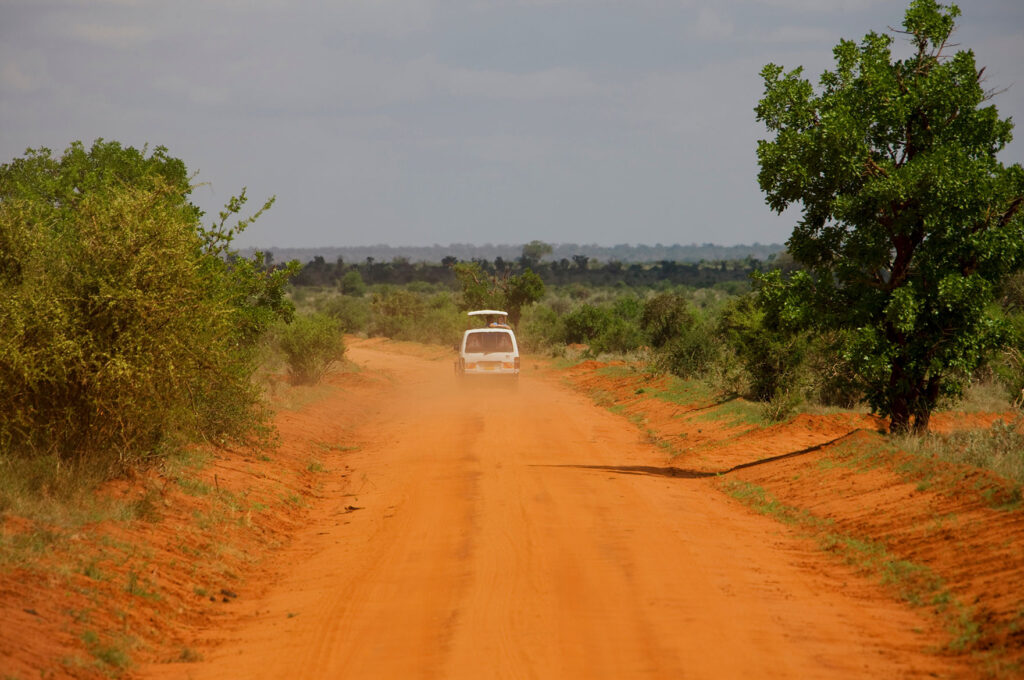
Rwanda has two wetter periods, roughly March to May and October to November. During these months, red clay roads turn slick within minutes of a downpour.
- Start park drives early, since storms often build in the afternoon.
- Allow extra time on every dirt section.
- Avoid driving through water if you can’t see the bottom.
- After a storm, wait 30 minutes if possible; surfaces often drain quickly.
Rain also brings advantages, such as green scenery and fewer visitors. With the right technique, it is very manageable.
If You Get Stuck
Getting stuck is not a disaster if you stay calm. First, stop spinning the wheels, because that only digs you deeper.
- Get out and look at all four wheels to see which ones have lost grip.
- Engage 4L and, if fitted, the diff lock.
- Clear mud from in front of the tyres and add stones or branches for grip.
- Try reversing out along your own tracks, which are already compacted.
- If that fails, use a tow strap with another vehicle, attached only to proper recovery points.
Inside a park, rangers and other drivers usually help. Outside parks, villagers often come to assist. Finally, call us if you need a recovery vehicle.
Respecting Parks and Wildlife Off Road
In parks, off-road means on unpaved tracks, not across open ground. Driving off marked tracks damages habitat and is against park rules. Also, keep to the posted speed limits, which protect animals and reduce dust.
Give elephants and buffalo plenty of space, and never get between a mother and her young. Keep engines running when close to large animals so you can move away. For park-specific rules, check our Akagera National Park page.
Daily Vehicle Checks for Rough Roads
Rough tracks are hard on tyres and suspension. A quick morning check spots problems early.
- Walk around and look for cuts or bulges in the tyres.
- Check that the spare is inflated and the jack is in place.
- Look under the car for fresh drips.
- Test brakes gently at low speed before your first descent.
FAQ: Off-Road Driving in Rwanda
Do I need off-road experience to self-drive in Rwanda?
No. Most routes are tarmac, and the dirt sections are short. A pick-up briefing and the techniques above are enough for most drivers.
When should I use low range?
Use 4L for steep climbs and descents, deep mud and rocky sections. Use 4H for general gravel and wet tracks.
Can I drive off the tracks in Akagera?
No. Stay on marked tracks at all times. Off-track driving is not allowed and harms the habitat.
Which vehicle is best for off-road sections?
A Land Cruiser handles the roughest tracks most easily. A Prado or RAV4 suits lighter use in dry weather.
Book a Trail-Ready 4×4
Tell us your route and travel month, and we will match you with a vehicle and a pick-up briefing to suit. WhatsApp or call +250 725 074659, or email info@4x4carrentalrwanda.com. More options are on our self drive Rwanda page.