
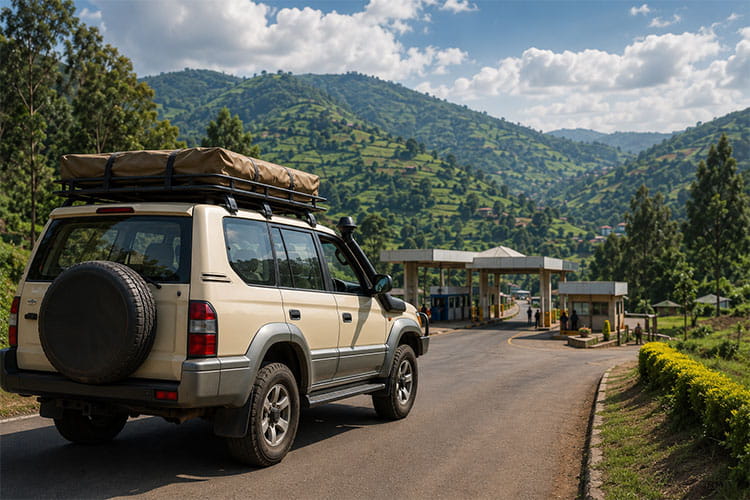
The best part of a Rwanda driving holiday is freedom: staying an extra night by the lake, or chasing clear weather to the volcanoes. Yet total freedom can backfire when permits sell out or a long drive eats your day. This guide shows you how to build a route that has fixed anchors where you need them and flexibility everywhere else.
Start With Your Fixed Anchors
Some parts of any trip cannot move. Lock these in first, then build the flexible parts around them.
- Arrival and departure flights: these set your total number of days.
- Gorilla trekking permits: issued for a specific date. The permit costs US$1,500 and peak dates sell out early.
- Chimp tracking in Nyungwe: also date-specific, with limited daily slots.
- Special events: such as Kwita Izina, the gorilla naming ceremony, if it falls in your dates.
Once these are set, every other night can stay open or be booked with free cancellation. In short, anchor the scarce things and leave the rest loose.
Build Your Rwanda Driving Holiday in Regions
Instead of planning day by day, think in regions. Rwanda divides neatly into four driving zones, each with its own base towns.
| Region | Base towns | From Kigali | Ideal stay |
|---|---|---|---|
| East: Akagera | Park lodges or Kayonza | About 2.5 hours | 1–2 nights |
| North: Volcanoes | Musanze, Kinigi | 2–2.5 hours | 2–3 nights |
| West: Lake Kivu | Rubavu, Karongi, Rusizi | 3–3.5 hours to Rubavu | 2–4 nights |
| South-west: Nyungwe | Forest lodges, Huye en route | 5–6 hours | 2 nights |
Then link the regions in an order that avoids backtracking. A common flow is east first, then back through Kigali, north, west along the lake, and finally south-west before returning. Because each region is a “block”, you can stretch or shrink it as you go.
Add Buffer Days and Swap Options
Flexibility needs spare time. Without it, one rainy day or a tired group forces you to drop something you wanted to see.
Where to put buffer days
- After arrival: one easy day in Kigali to recover from the flight and collect the car.
- Before a fixed permit: arrive in Musanze a day early, so traffic or weather cannot make you miss your trek.
- Near the end: a free day on Lake Kivu is the perfect flexible slot. Use it to rest or catch up on anything missed.
Swap options for rainy days
Have a plan B in each region. In Musanze, swap a hike for the Musanze caves or a twin lakes drive. On Lake Kivu, swap a boat trip for a coffee or tea estate visit. In Kigali, museums and galleries work well on wet afternoons.
A sample 12-day flexible outline
- Days 1–2: Kigali. Arrive, rest, collect the car.
- Days 3–4: Akagera. Game drives and a boat trip.
- Days 5–7: Musanze. Buffer day, then gorilla trek on the permit date.
- Days 8–9: Rubavu and the Lake Kivu shore. One fully flexible day.
- Days 10–11: Nyungwe. Chimp tracking and the canopy walk.
- Day 12: Return to Kigali for your flight.
Only days 6 and 10 are truly fixed. Everything else can shift by a day without breaking the plan. For example, if Akagera is especially rewarding, stay a third night and trim the Kivu block instead.
Choosing a Vehicle That Keeps Options Open
A flexible route needs a flexible vehicle. If you might take a side track to a viewpoint, or reach a rainy trailhead, a 4×4 keeps those options available.
- Land Cruiser Prado: comfortable on tarmac and capable on rough side roads. A great all-round choice.
- Land Cruiser Safari: best if Akagera game drives are a big part of your plan.
- Toyota RAV4: fine for dry-season trips that stay mostly on tarmac.
Also, ask about unlimited kilometres. Detours are the whole point of a flexible trip, so you do not want to count every kilometre. Our self-drive Rwanda page explains what is included with a typical rental.
Daily Driving Rules of Thumb
Rwanda’s roads are good, but they are hilly and busy with people. So distances take longer than maps suggest.
- Average 40–50 km/h on main roads once you include towns and bends.
- Keep most driving days under four hours. Save the long Nyungwe leg for a single full day.
- Leave by 8 am, and aim to arrive by 5:30 pm. Darkness falls around 6 pm year-round.
- Fill up in big towns, because stations are fewer near parks.
- Rwanda drives on the right, and speed cameras are common.
For route inspiration with realistic timings, see our road trips in Rwanda page.
Extending the Route Beyond Rwanda
A flexible plan can also cross a border. The Katuna (Gatuna) crossing to Uganda is about 1.5 hours from Kigali, and Cyanika near Musanze leads to Mgahinga and Bwindi. However, crossing with a rental car needs written authorisation and COMESA insurance, arranged in advance.
Remember that Uganda, Kenya and Tanzania drive on the left. Build an extra buffer day around any border crossing, since formalities can take time. Our cross-border car hire page covers the paperwork.
Frequently Asked Questions
Should I book all my accommodation before I arrive?
Book the nights linked to permits and peak dates. For other nights, choose places with free cancellation or book a day or two ahead.
How many days do I need for a flexible Rwanda road trip?
Ten to fourteen days lets you visit all four regions with buffer days. A week works if you drop one region.
Can I change my route after collecting the car?
Yes, within Rwanda. Just let the rental company know if you plan to cross a border or return the car somewhere else.
What is the best flexible day to keep free?
A spare day on Lake Kivu. It is easy to drop or extend, and it is a lovely place to rest.
Plan Your Route With Us
Share your flight dates, any permits you hold and the regions you want to see. We will help you shape a flexible plan and the right vehicle. WhatsApp or call +250 725 074659, or email info@4x4carrentalrwanda.com.