
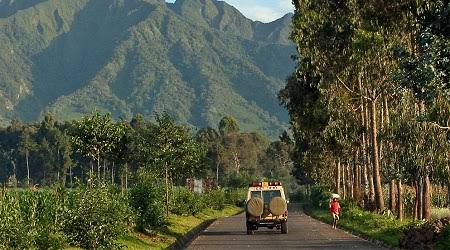
Rwanda mountain roads are smooth, scenic and well built, yet they rarely run straight for long. Hairpin bends, long climbs and sudden mist test drivers who are used to flat highways. These car hire tips will help you drive the hills calmly and safely, from Kigali to the volcanoes and the rainforest.
What Makes Rwanda Mountain Roads Different
Almost every main road in Rwanda climbs, twists and drops again. The country sits on a high plateau, so even short trips include long gradients. On top of that, villages line many routes, which means people, bikes and livestock share the road.
The routes with the most hills
- Kigali to Musanze: 2–2.5 hours of winding climbs toward the Virunga volcanoes.
- Musanze to Rubavu: a scenic descent toward Lake Kivu with tight bends.
- Huye to Nyungwe: the forest road is steep, twisty and often wet; the full trip from Kigali takes 5–6 hours.
- The Kivu lakeside road: slow, narrow and beautiful, with constant curves.
None of these roads is dangerous if you drive at a sensible pace. However, they are tiring, so plan shorter driving days than you would at home.
Choosing a Car Hire for the Hills
Your vehicle makes a big difference on long climbs. A small, underpowered car struggles uphill when fully loaded, and its brakes work harder on the way down.
Engine and gearbox
A diesel 4×4 like the Land Cruiser Prado pulls steadily up gradients without constant gear changes. Manual and automatic both work. However, an automatic with a manual mode lets you hold a low gear on descents.
Ground clearance
Main roads are tarmac, but lodges and trailheads often sit at the end of rough tracks. Higher clearance protects the underside from rocks and ruts. For trailheads near Volcanoes, a 4×4 is the safer choice.
Size and load
More passengers and luggage mean more weight on the climbs. If you’re a family or group, consider a larger vehicle such as the Land Cruiser Safari rather than squeezing into a compact SUV.
Climbing and Descending Without Stress
Good hill technique is mostly about planning ahead. Once you get into a rhythm, it becomes second nature.
Going uphill
- Choose a lower gear before the climb gets steep, not halfway up.
- Keep a steady speed rather than surging and braking.
- Leave extra space behind slow trucks, which may stop suddenly.
Going downhill
- Use engine braking by selecting a lower gear.
- Brake firmly before a bend, then release through it.
- Avoid riding the brakes for long stretches, because they can overheat and fade.
- If you smell hot brakes, pull over safely and let them cool.
Hairpins and blind bends
Stay in your lane, which is the right-hand side in Rwanda. Slow down before the curve and look as far through it as you can. A short tap of the horn before a blind bend is common practice on rural roads.
Overtaking and Sharing Narrow Roads
Overtaking on mountain roads is where most risk lies. Solid lines mark places where you must not pass, and police enforce them. So be patient behind slow vehicles until you reach a clear straight.
Who you’ll meet on the road
Cyclists often carry heavy loads uphill, so they wobble. Pedestrians walk on the edge, and children may cross without looking. Meanwhile, goats and cattle appear near villages. Therefore, lower your speed in every trading centre, where the limit usually drops anyway.
Letting others pass
If a local driver is close behind, pull over where it’s safe and let them by. It reduces pressure and lets you enjoy the views.
Weather, Mist and Rain on Rwanda Mountain Roads
Weather in the hills changes quickly. Mist can roll over the Nyungwe road and the volcano foothills, cutting visibility within minutes.
Driving in mist
Switch on dipped headlights, slow right down and increase your following distance. Use the road edge or centre line as a guide. Never stop on the carriageway itself.
Driving in rain
Rain makes tarmac slippery, especially on painted lines and downhill bends. It can also wash mud or small stones onto the road. Rwanda’s two rainy seasons run roughly March to May and October to November, so allow extra time then.
Timing your drive
Afternoon storms are common in the wet months. As a result, an early start often gives you clearer roads and better light. Aim to finish before dark, because mountain roads have little lighting.
Practical Car Hire Tips Before You Set Off
A few checks at pickup make hill driving far easier.
- Test the brakes and handbrake in the yard.
- Check tyre tread and pressure, including the spare.
- Ask how to engage low range if the car has it.
- Make sure the wipers and demister work well.
- Download offline maps, as signal drops in valleys.
Plan rest stops
Concentrating on bends for hours is tiring. So break long drives into stages, for example a coffee stop in Musanze or a lunch break in Huye. Swapping drivers, if two of you are listed on the agreement, also keeps you sharp.
Also keep water and snacks in the car, because hill routes can be slower than maps suggest. If winding roads don’t appeal, you can always book a 4×4 with a local driver for the steepest legs. For more route ideas, see our Rwanda road trips page.
FAQ
Are Rwanda mountain roads paved?
Most main routes are good tarmac. However, the final stretch to some lodges and trailheads is gravel or dirt.
Do I need a 4×4 for hilly routes?
Not for tarmac alone. A 4×4 helps with steep gravel access roads, heavy loads and wet-season conditions.
Which hill route is the most demanding?
The forest road through Nyungwe is the twistiest and often misty. Allow plenty of time and drive it in daylight.
How do I avoid brake fade on long descents?
Use a lower gear so the engine slows the car, and brake firmly in short bursts instead of constantly.
Drive the Hills With Confidence
Tell us your route, and we’ll suggest the right vehicle and timing for the climbs. WhatsApp or call +250 725 074659, or email info@4x4carrentalrwanda.com.