The last lion disappeared in 2001. Nobody made a ceremony of it. There was no…
Coming Face to Face with a Silverback | What Gorilla Trekking in Rwanda Really Feels Like
The ranger’s voice was barely a whisper. “Do not run. Do not make direct eye contact. Do not scream.”
He said it almost apologetically, as if he knew the instructions were useless — that when the moment came, the body would forget every rule and simply feel. We were standing at the edge of a bamboo thicket on the forested slopes of the Virunga Volcanoes, our boots already caked in red volcanic mud, our lungs still adjusting to the altitude. Somewhere inside that dense green wall of vegetation, a family of mountain gorillas was having breakfast.
Nothing prepares you for what comes next.
The Permit: Your Golden Ticket to the Canopy
Getting here starts months before the mud and the altitude. Rwanda’s gorilla trekking permits are issued through the Rwanda Development Board and cost $1,500 per person — a figure that makes most people pause. It is not cheap. It is not meant to be.
The high price is conservation strategy as much as it is tourism economics. Revenue flows back into Volcanoes National Park, into anti-poaching units, into community programs that give the people living on the park’s edge a financial stake in the gorillas’ survival. There are roughly 1,000 mountain gorillas left on earth, and more than half of them live in the interconnected forests of the Virunga Massif — shared between Rwanda, Uganda, and the Democratic Republic of Congo. Rwanda’s portion, Volcanoes National Park, protects ten habituated gorilla families, with each family accepting exactly eight visitors per day, for exactly one hour.
One hour. You’ll think that sounds like plenty until you’re standing in the forest counting every minute.
Permits sell out months in advance, particularly in peak season between June and September, and again in December and January. Book through the RDB website directly, or work with a licensed tour operator — many lodges near the park, including the celebrated SingitaKwitonda and the mid-range Sabyinyo Silverback Lodge, can assist with bookings and handle logistics. Your permit assigns you to a specific gorilla family, and that assignment determines your trek’s difficulty. Some families roam higher up the volcanic slopes. Others linger in lower bamboo zones. You won’t know exactly what you’re in for until the morning briefing.
Dawn at the Trailhead: The Briefing
We gathered at the park’s main trailhead near Kinigi at seven in the morning, bleary-eyed from an early wake-up, clutching cups of tea provided by our lodge. The sky over the volcanoes was the pale grey of early light, and the air had a sharpness to it — cool and green and alive with birdsong.
The briefing lasted about twenty minutes. A park official walked us through the rules with the patience of someone who has given this speech thousands of times but still means every word of it. No flash photography. Stay seven metres from the gorillas at all times — though he smiled slightly when he said it, as if acknowledging that the gorillas themselves have not read this rule. If a gorilla charges, do not run. Crouch down. Look away. Let it pass.
The gorillas we’d be visiting, he explained, were the Susa group — one of the largest families in the park, famous for being the group that the primatologist Dian Fossey studied most closely in the 1970s. The group was currently high on the slopes of Mount Karisimbi, which meant a challenging trek. He was not wrong.
The Trek Itself: Mud, Altitude, and Stinging Nettles
There is a version of gorilla trekking that takes forty-five minutes each way on gentle terrain, and there is a version that takes four hours each way through dense forest, stinging nettles, and altitude that makes your temples pound. We got the second version.
The trail begins through farmland — small plots of pyrethrum flowers and potato fields that press right up against the park boundary — before the vegetation thickens and the canopy closes in overhead. Your guide moves with calm authority, occasionally radioing ahead to the trackers who have been following the gorilla family since first light, triangulating their position. The trackers are the invisible architects of this experience; they are in the forest before the tourists arrive and they stay after the tourists leave.
I was grateful I had listened to the advice to hire a porter. For around $15, a local man carried my daypack, extended a hand on steep sections, and — when I slipped in the mud and took out the person behind me — helped us both up without a flicker of judgment. He had done this trail hundreds of times. He made it look effortless.
Ninety minutes in, breathing harder than I would like to admit, the lead ranger raised his hand. The radio had crackled. We were close.
The Hour That Changes Everything
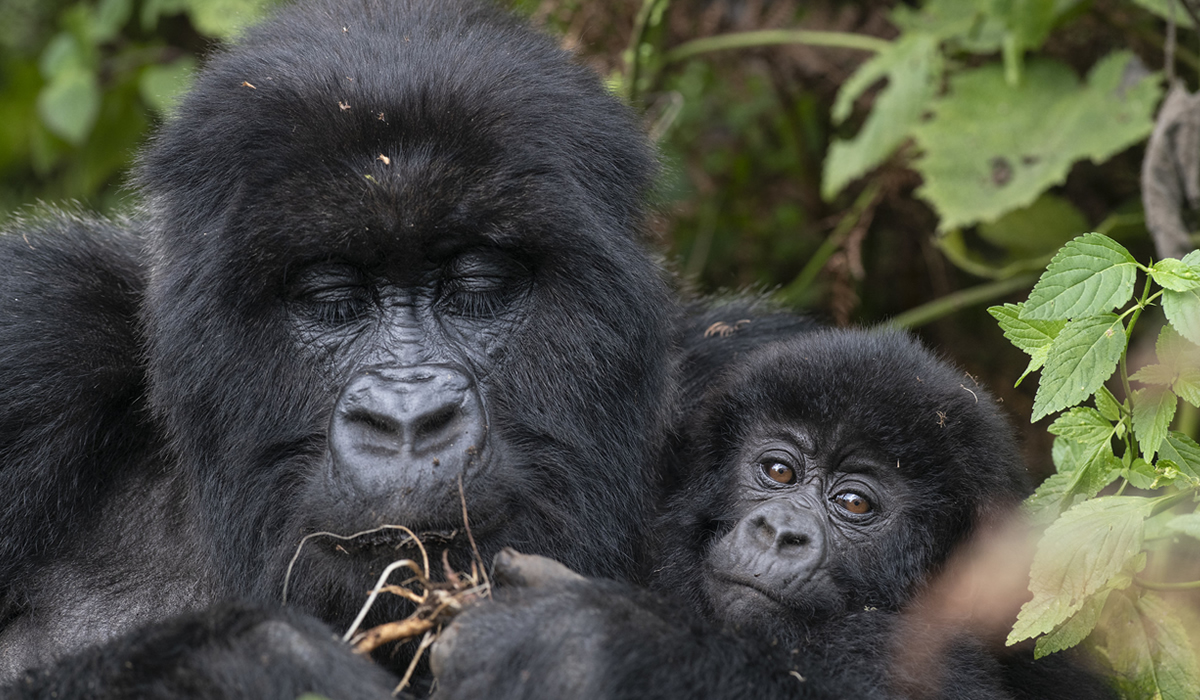
The first thing you notice is the smell — dense, warm, animal, not unpleasant. Then movement. A juvenile, maybe three years old, swinging through the branches above with total confidence. Then another. Then a mother, seated in a shaft of light, an infant clinging to her chest so tightly it might have been sewn there.
We crouched. We stopped talking. The forest did not.
The silverback was sitting about twelve meters away when we first spotted him, his back turned, pulling methodically at a clump of vegetation. Silverbacks are enormous — adult males can weigh up to 200 kilograms — but what strikes you is not the size so much as the presence. There is an authority in the way he occupies space that has nothing to do with aggression. He simply is, completely and without apology, and the forest arranges itself around him.
Then he turned and looked directly at me.
I forgot every instruction. I forgot my camera. I forgot that I was cold and muddy and slightly out of breath. What I felt in that moment was something I struggle to articulate even now — a recognition, maybe. An awareness, looking into those amber eyes, that intelligence was looking back. Not human intelligence, but something older. Something that has been sitting in forests like this for far longer than we have been wandering into them with permits and rain jackets.
The hour passed in what felt like ten minutes. The juveniles tumbled and played. The silverback moved to a new patch of vegetation and fed with the slow deliberateness of someone who has no predators and no deadlines. An adolescent male tested the patience of the silverback by getting too close, received a short, sharp grunt in response, and retreated. The mother with the infant shifted position, and the baby peered out at us with a curiosity that was almost unbearable in its openness.
When the ranger signalled that our time was up, nobody moved immediately. We stood and looked for another few seconds, storing it — all of us knowing that photographs, however good, would not quite hold what we were feeling.
What It Costs, and What It’s Worth
Rwanda’s approach to gorilla tourism is one of the most studied conservation models in the world. Since the 1980s, the mountain gorilla population has grown — the only great ape whose numbers are moving in the right direction — and responsible tourism is a central reason why. Local communities receive a percentage of permit revenue. Former poachers are retrained as trackers and rangers. The economic value of a living gorilla vastly outweighs any alternative use of the land.
The $1,500 permit is a conversation starter that often ends with resentment, and I understand the reflex. But consider what it buys: the infrastructure to protect one of the rarest animals on earth, jobs for communities who might otherwise be in conflict with conservation goals, and a managed, limited experience that minimises stress on the animals themselves. You are not at a zoo. You are a guest in someone else’s home, and the price of admission is the price of keeping that home intact.
Before You Go
The logistics matter. Base yourself near the park in Musanze, which has accommodation at every price point. The rainy seasons — April to May and October to November — offer lower prices and fewer crowds, though the trails get genuinely difficult. Pack gaiters, proper hiking boots, long sleeves for the nettles, and a rain cover for your camera. Leave the bright colours at home; neutral, muted tones are better for the animals.
And when the ranger tells you not to make direct eye contact with the silverback — nod, agree, and understand that you will absolutely make direct eye contact with the silverback. You won’t be able to help it.
Neither will he.
Related Posts